Español
 Русский

Panamax ships (with a deadweight of 60,000 to 90,000 tons) are one of the main ship types for international bulk cargo transportation.
They can pass through the Panama Canal and are suitable for medium-range transportation of grains, coal, etc.
Their design meets the navigation restrictions of the Panama Canal (overall length ≤ 274.32 meters, breadth molded ≤ 32.30 meters).
The loading operations for these ships have extremely high requirements for equipment efficiency, flexibility, environmental protection,
and adaptability.
Core Ship Loader Types
Rail-Mounted Ship Loader
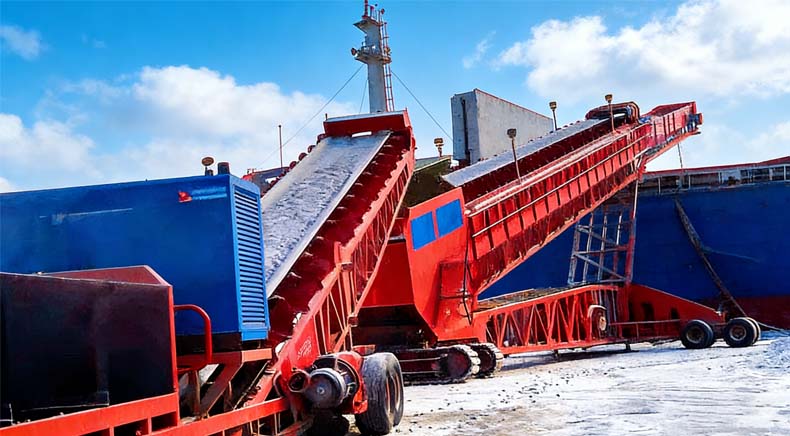
Rail-mounted ship loaders move along fixed rails on the wharf and, together with telescopic boom conveyors, can cover all hatches of Panamax
ships, making them a common configuration in large bulk cargo terminals. Their technical features focus on "continuous operation" and "high
throughput": they are usually equipped with Conveyor Belts 1000-1800mm wide, with a belt speed of 2.0-3.15m/s.
A single unit can achieve a loading capacity of 2000-4500 tons per hour, efficiently handling bulk commodities such as coal, iron ore, and grains.
In terms of environmental protection design, rail-mounted ship loaders generally integrate enclosed conveyor covers, Z-type guide chutes,
and buffer plates, which can effectively reduce dust emission when materials fall. Some high-end equipment is also equipped with dry fog
dust suppression systems, enabling dust emission to be controlled below 5mg/m³, meeting international environmental standards such as
EU CE and US EPA.
Disadvantages: Poor flexibility, as they rely on fixed rails for operation. The laying of rails increases the initial site construction cost;
moreover, the fixed rail positions cannot adapt to temporary changes in wharf terrain or ship berthing positions, requiring
high forward-looking planning for the wharf.
Mobile Radial Ship Loader
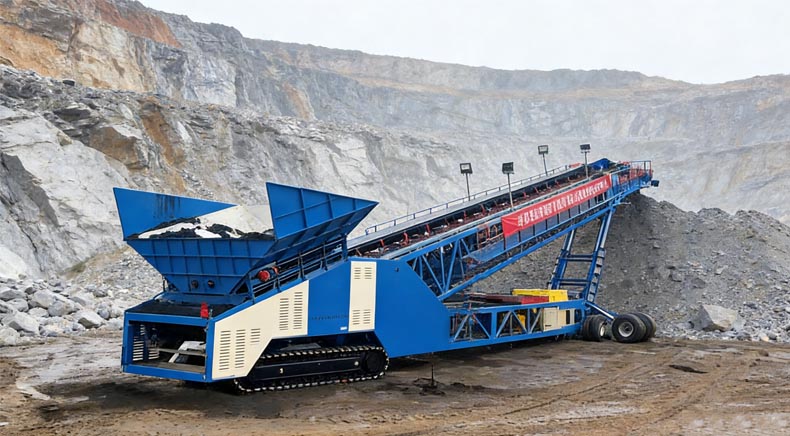
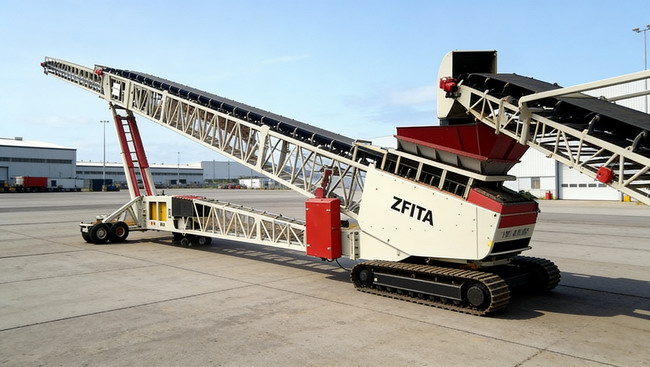
Mobile radial swing telescopic ship loaders have "flexibility" as their core advantage. Driven by hydraulics, they can achieve ±110°
radial swing and 35-55m boom telescoping, covering multiple hatches of Panamax ships from a single feeding point, thus significantly
reducing equipment movement time. Their loading capacity ranges from 500 to 6000 tons per hour, which can meet the medium
through put needs of small and medium-sized terminals and handle high-load scenarios in large ports through multi-unit collaborative operations.
In terms of structural design, such equipment usually adopts a modular design, which can be disassembled and transported via
40-foot containers, suitable for cross-border deployment by overseas customers. The integration of wireless remote control and PLC
control systems enables single-person operation, reducing labor costs. Leading Mobile Ship Loaders like those from Zfita have added
intelligent load sensing functions on this basis, which can monitor material flow in real-time and automatically adjust the boom angle
to avoid overloading or uneven loading, with the loading accuracy error controlled within 3%.
Disadvantages: Mobile radial ship loaders have poor stability during movement. When under heavy load (such as loading iron ore),
they are prone to shaking due to uneven ground, requiring supporting flat sites or auxiliary support devices; second, operation must be restricted
in windy weather (wind speed ≥ 10m/s), otherwise, it may cause boom vibration; third, the energy consumption of a single unit is 15%-20%
higher than that of rail-mounted ship loaders, which will increase operating costs during long-term high-load operation.
Screw Ship Loader
Featuring an fully enclosed screw conveying design, it is suitable for dust-free loading of powdery materials (such as cement, sulfur).
It adopts a scissor arm arrangement, which can go deep into narrow areas inside the cabin to avoid dust emission caused by free fall of materials;
the loading capacity can reach 12,000 tons per hour.
Disadvantages: The application range of screw ship loaders is narrow: first, they cannot handle bulk materials with a particle size exceeding
50mm (which is easy to jam the screw blades); second, materials are prone to being crushed during conveying, making them unsuitable for
goods requiring high particle integrity (such as grains); third, friction between screw blades and the machine shell generates heat,
which may cause material caking (such as cement) in high-temperature environments, requiring supporting cooling systems.